
Project

Project Introduction

Miraion

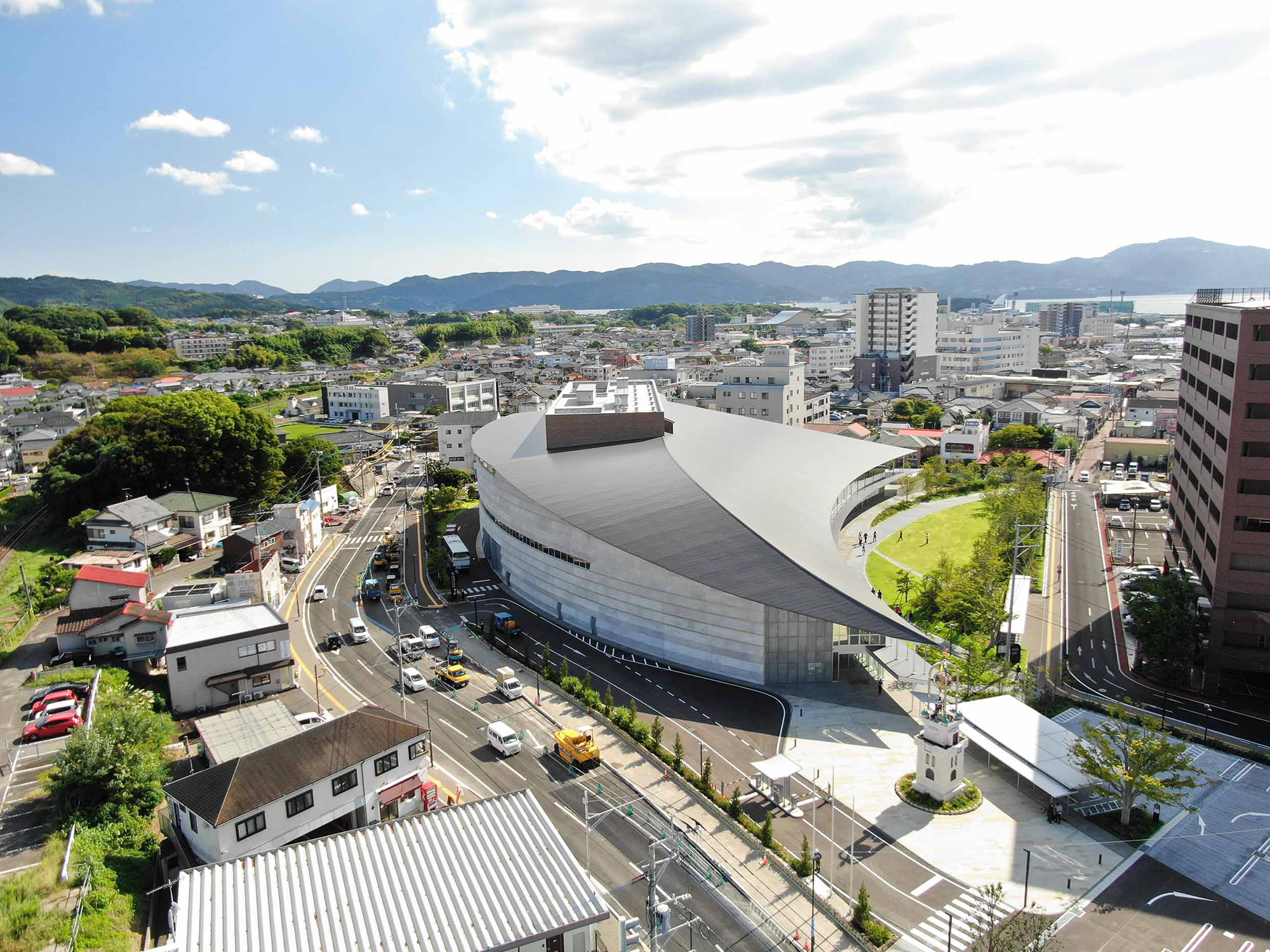
Miraion (Nagasaki Prefectural Nagasaki Library and Omura City Library, Omura City Museum of History)

Miraion is a proposal that serves as a prototype for libraries, whose role is undergoing a major transformation. In addition to being only the second joint prefectural and municipal library in the country, we worked to create a space that fosters the unique encounters with books that only a library can provide in an era where books can be bought online.

The project site is located on an alluvial fan overlooking Omura Bay, with Mt. Tara in the background. We envisioned a "bay"-like shape that connects this nature-rich environment with the central urban area and draws in the flow of the town. Beneath the generous embrace of the "bay-shaped single roof," a rich space for spending time with books is created. This place features a stepped "terrace library" that connects the first through fourth floors, creating a space where everyone can spend their time just as they like.
This reading space, called "Book Kadan (Flower Bed)," lives up to its name by allowing carrels and reading rooms to be rearranged just like replanting flowers.
And the cores of the administrative rooms and closed stacks, which cross each floor and have independent circulation paths, are positioned as the base and heart supplying library service, and named "Book Dock," inspired by the local character of Nagasaki.

Under a single curved roof, we intended for the space where "Book Dock" and "Book Kadan" merge to create a seamless experience in which library activities and scenery flow continuously together.

  • Takeshi Watanabe

    Takeshi Watanabe

    Joined the company in 1990

    Tokyo 1st Office, 2nd Design Department

    Architectural Design: From proposals to working drawings and construction supervision

    I proposed a shape suitable for this location in Omura City. Although this is only the second joint prefectural-municipal library building, it is a new building type that currently only we are working on. The design experience, involving trial and error, has been extremely valuable, allowing us to work through it while constantly gaining new insights.

  • Tomoyuki Ushigome

    Tomoyuki Ushigome

    Joined the company in 2007

    Tokyo 1st Office, 2nd Design Department

    Architectural Design: From proposals to working drawings and construction supervision

    The continuous studio-like space is a unique feature of this library. I believe we have created a prototype in the sense that, even when moving through the space, activities are not fragmented, allowing for a three-dimensional experience where a continuous journey is created within a single space.

  • Chisa Inui

    Chisa Inui

    Joined the company in 2011

    Tokyo 1st Office, 2nd Design Department

    Architectural design: In charge of proposals

    I thought deeply about the significance of having this type of building in this location, considering factors like Omura Bay and the urban area, as well as the approach of the prefectural and municipal governments jointly operating the library, and formulated a proposal. The joy of seeing a proposal take shape is, I believe, the true thrill of design.

  • Ayumu Kinukuro

    Ayumu Kinukuro

    Joined the company in 2007

    Structural Design Office, Engineering Division

    Building structure: in charge from proposal to working design

    The defining feature of this building, reminiscent of a bay, is the large roof that covers the entire structure. To achieve this curved roof while keeping interior columns to an absolute minimum, we put forward numerous structural proposals. I believe this challenging experience will also inform our future designs.

  • Hideyuki Sekine

    Hideyuki Sekine

    Joined the company in 2013

    Environmental Design Office, Technical Headquarters

    Environment and Electricity: In charge of proposals

    When achieving the first ZEB Ready certification for a library, there was also a lot that could be done from the perspective of electrical equipment. In addition, lighting is extremely important in reading spaces. I believe we were able to be involved from both design and technical aspects.