

Yokohama City Citizens Hospital
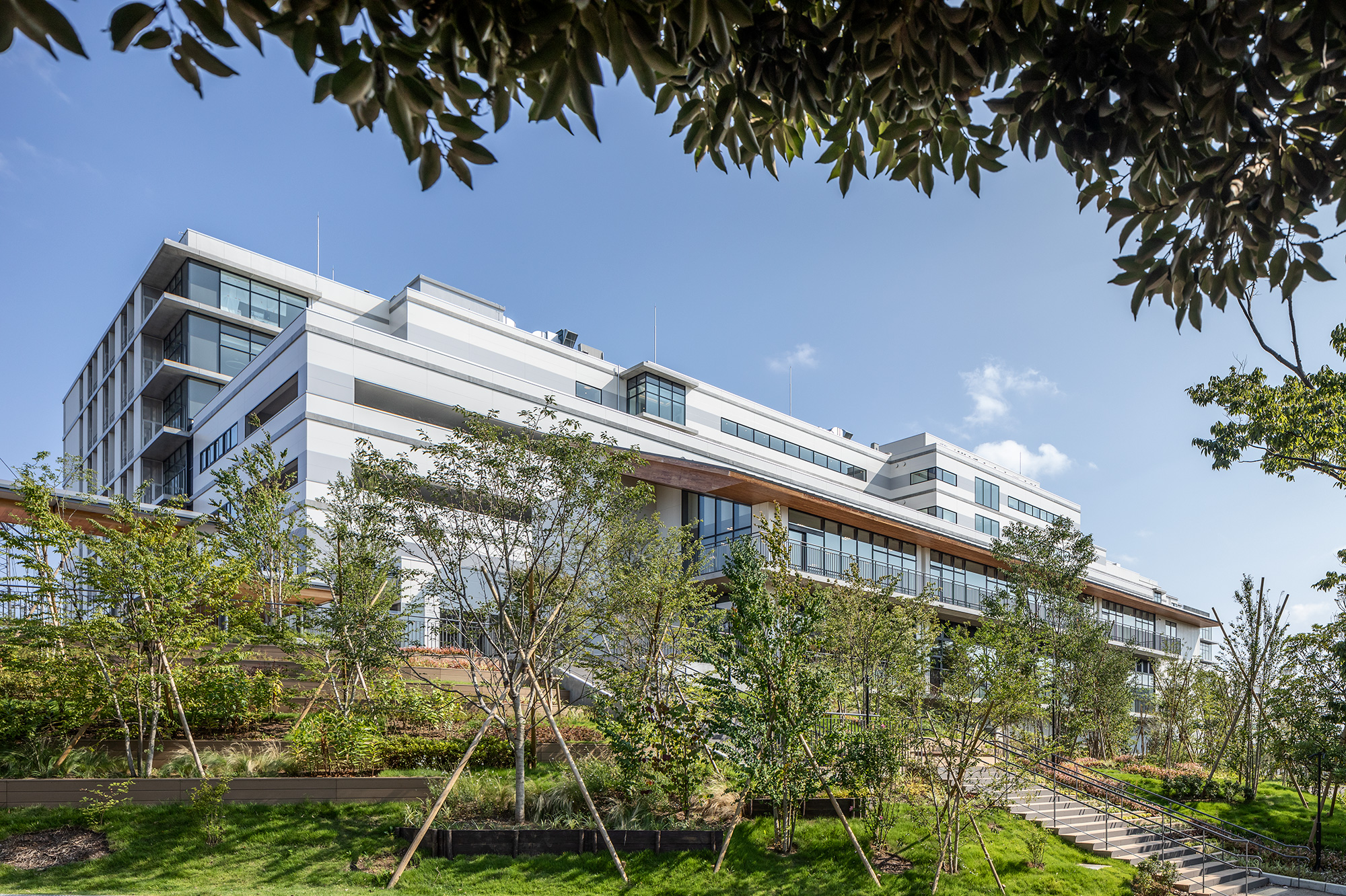
A "park hospital" that coexists with the park
This is a rebuilding project for Yokohama City University Medical Center, which has provided necessary medical care to the region, focusing on advanced and acute-phase medical care as a core hospital in Yokohama City.
We addressed the conflicting challenges of creating a quiet healing environment that utilizes the nature of Mitsuzawa Park adjacent to the hospital, while simultaneously protecting patient rooms from the cheers and lighting of NHK Spring Mitsuzawa Football Stadium, where J.League soccer matches are also held.
As a "park hospital" that emphasizes coexistence with the park, the green spaces are planned to be continuous with the park. A convenience facility building housing a cafe and a convenience store—accessible to park visitors and event spectators as well—is placed on the north side of the site, aiming to reduce the sense of oppression caused by the massive volume of the hospital.
To reduce the impact of the athletic field on the north side, we proposed a uniquely arranged ward layout in Japan where three wards are lined up horizontally without any north-facing patient rooms. The patient rooms are arranged to surround the staff station, creating a plan that shortens nursing traffic lines and facilitates easier observation.
Under the supervision of Kiyoshi Nishikawa, Professor Emeritus at the University of Tsukuba, the outpatient clinic floor features graphic signs designed to appeal to visitors' memory, creating a hospital where it is easy to navigate even down long corridors.
As Kanagawa Prefecture's only designated Type 1 infectious disease medical institution, our hospital has an infectious disease ward located in a section of the top 7th floor. By connecting the infectious disease outpatient department—which features a dedicated entrance—directly to the ward via a private elevator, it is possible to transfer patients while maintaining isolation. The infectious disease ward consists entirely of private rooms, including two designated Type 1 infectious disease rooms, which have been continuously utilized for the current COVID-19 pandemic.