

Special feature
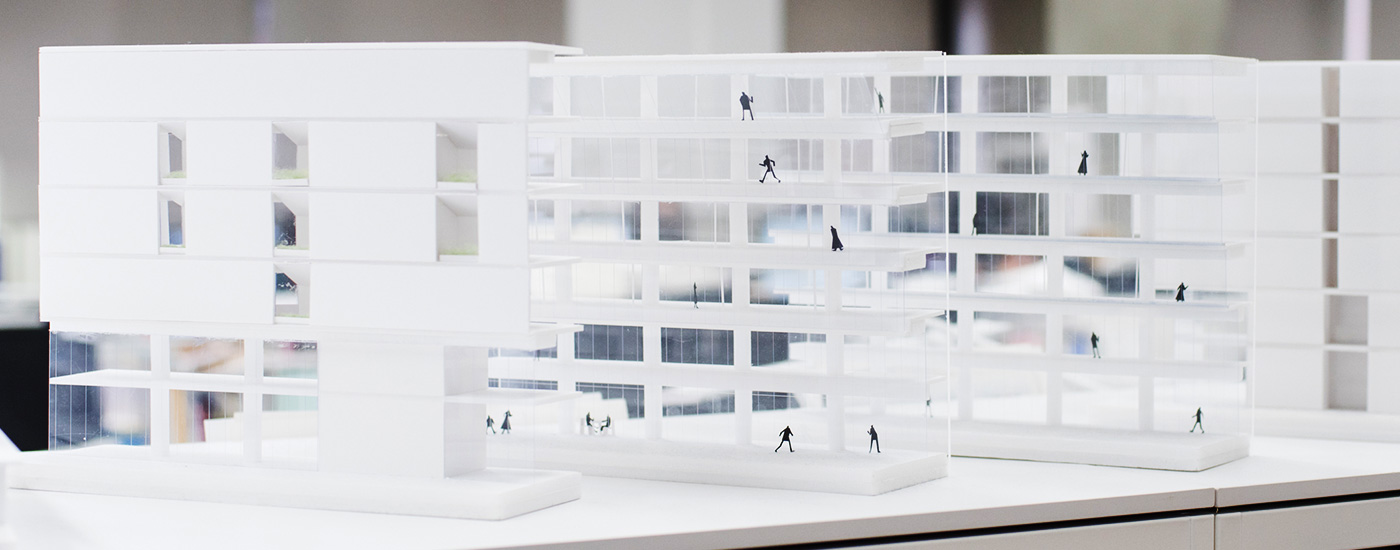
Proposal of seeds: Toward building a new compact city
Introduction
Japan's social structure is undergoing major changes due to population decline and aging. It is clear that the way our cities are designed can no longer function the way it did during the growth period. In reality, regional cities are declining, and even in major metropolitan areas, the wave of the declining birthrate and aging population cannot be stopped. We, as those who propose urban designs and architecture, cannot simply sit back and do nothing in the face of this situation.
We believe that thinking about the future of cities and architecture, and proposing new ways for cities to exist, is both the mission and responsibility of an architectural design firm.
As one of these initiatives, AXS Satow has decided to undertake a social contribution activity called "seeds proposals." The proposal we are presenting this time focuses on issues related to cities that we are currently facing. Our aim is to re-examine, from a fresh perspective, the compact city concept that is currently being advocated as one form of urban revitalization.
social change
Entering the 21st century, society has shifted from an industrial society to an information society driven by the development of IT technology. Influenced by globalism as well as Japan's unique social and economic conditions, this information society is creating new social structures. Though it is a cliché, Japan has transitioned from a growth society to a mature society. Concrete manifestations of this include responses to population issues, a shift in interest from material abundance to emotional fulfillment, and the associated changes in industrial structures, lifestyles, and communities.
Above all, population decline is an event no modern society has ever experienced, and we have yet to come up with effective countermeasures against it. It is even projected that by 2040, the population in most municipalities outside major metropolitan areas will shrink to about 75 percent of what it is today. Furthermore, the problem of a declining birthrate and an aging population is severe.
Japan has the highest aging rate in the world. Changes in household composition due to the aging population will inevitably alter communities and the nature of living.
Also, while globalization is expanding, the sharing of local information is also progressing due to the development of the information society. In order to revitalize local communities, it will be necessary to promote industries rooted in the region.
The longing for "material abundance" and a "uniformly affluent society" that was strong in a growing society has already faded, and a lifestyle that seeks "emotional fulfillment" and "a personalized form of happiness" is becoming widespread.
In such a situation, urban structures no longer need to be merely materially prosperous. What should a city where people can live a spiritually rich life look like? As the population declines, cities do not need to expand any further. We believe that being able to live a rich life, even in a compact form, becomes more important.
Population decline is often discussed as a demographic onus, but shouldn't we shift our perspective and view a decreasing population in a mature society rather as a step toward societal maturation?
Connections in a mature society and the background of compact city development
In a growing society, cities rapidly expanded into the suburbs through sprawl, driven by the concept of scrap and build. However, once the population begins to decline, numerous gaps where people no longer live—namely, vacant houses—are created within the sprawling city. In these sponge-like cities, maintaining public infrastructure is no great feat. Currently, cities are failing to adapt to changes in society and industrial structures and are losing their vitality one after another, raising cries of a critical situation in which some 900 municipalities could disappear by 2040.
Common challenges in declining cities today include (1) the loss of vitality in central urban areas, (2) the hollowing out of suburban residential areas, (3) the increased burden of maintaining urban functions, and (4) the difficulty of sustaining public transportation.
Starting with the former three town-planning laws of 1998, followed by the revised three town-planning laws of 2006 and various other systems have been introduced, but they do not yet seem to have led to sufficient results.
In *The Image of the City* (1960), urban planner Kevin Lynch identified five key factors through which cities are visually perceived. We believe that the "node," one of these elements, will serve as a major reference concept. Furthermore, in her urban analysis *The Death and Life of Great American Cities* (1961), civic activist Jane Jacobs heavily criticized urban zoning doctrines. Bearing in mind this critique, rooted in the perspective of everyday citizens, we will explore what urban environments should look like in the coming era.
Toward the construction of a new compact city
Compact cities do not necessarily just pursue convenience in transportation and urban functions. They must be "healthy cities" befitting the coming era, and cities where people can live "flexibly," "at ease," and "compactly" while embracing "diversity" amid globalization.
We defined the new compact city as an urban area where people can live compactly centered around walking, with a resilient urban structure that balances the independence and cooperation of the center and the periphery, while the center (node) features overlapping and manifested distinct urban functions (layers).
Also, nature has been destroyed and consumed in cities for the sake of development. It is hard to say that current cities coexist with nature. However, originally, nature, humans, and cities should have been integrated. As we enter a mature society, we believe that cities need to reconnect with nature, such as greenery and water.
Based on these ideas, we make three recommendations.
Thinking about a new symbiosis with nature - Sumida River Seeds Proposal
We propose the creation of a nature city that strengthens the relationship between water (rivers), green nature, and the urban environment. Focusing particularly on the Sumida River, a symbol of Tokyo, we will explore ways to bring nature back to the city.
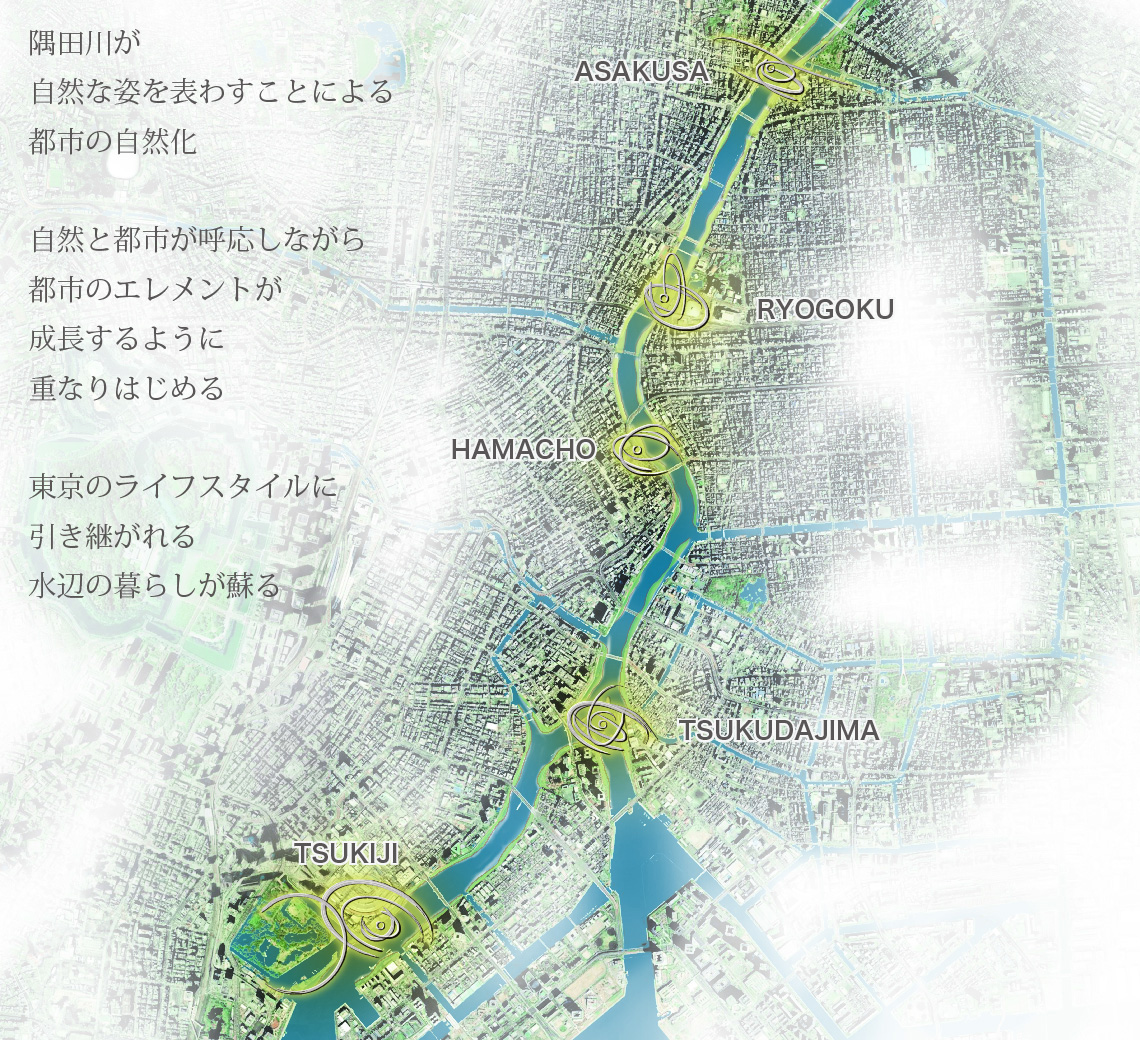
We propose the concept of a new secondary city center, the "Sumida River Secondary City Center," which will introduce new elements to the city—such as beautiful townscapes viewed from the river and transportation that is enjoyable in itself—connecting five areas along the Sumida River basin via a water transport network.
Toward the construction of a new compact city
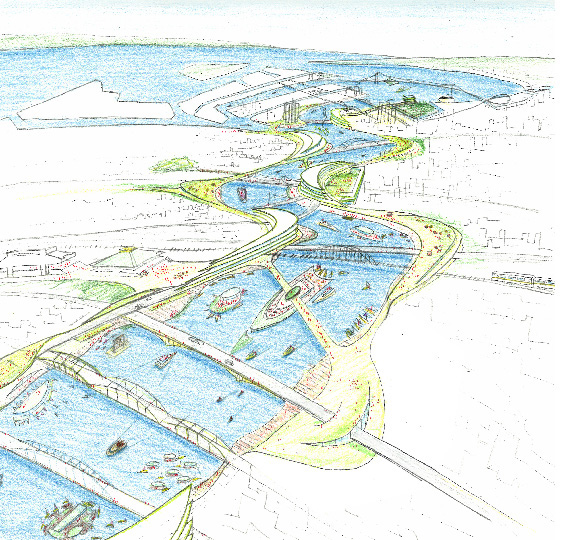
Especially for the Ryogoku area, as a high-potential zone where JR, subway, and water transport terminals intersect, we propose a vibrant area development plan.
Thinking about a new symbiosis with nature - Sumida River Seeds Proposal
We propose the creation of a nature city that strengthens the relationship between water (rivers), green nature, and the urban environment. Focusing particularly on the Sumida River, a symbol of Tokyo, we will explore ways to bring nature back to the city.
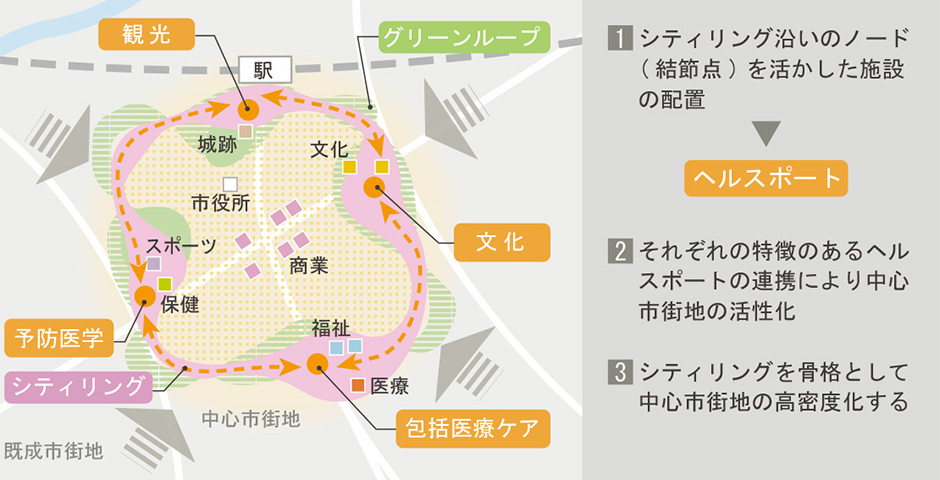
We propose the creation of a nature city that strengthens the relationship between water (rivers), green nature, and the urban environment. Focusing particularly on the Sumida River, a symbol of Tokyo, we will explore ways to bring nature back to the city.
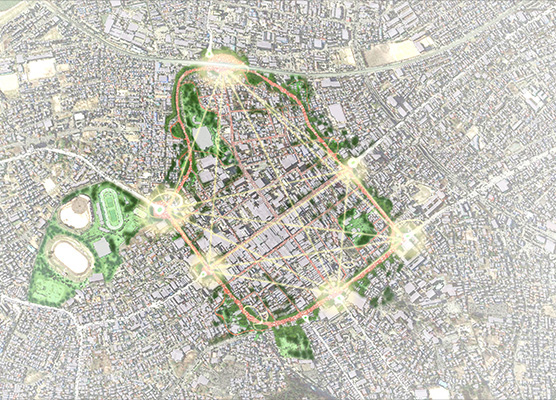
I applied the concept of a healthcare city to a regional city. By linking the diverse functions of the city with "health" as the key, we aim to realize a city with a high quality of life.
Rethinking New Urban Structures: The Junction City Initiative
We analyze the urban structure as an overlay of various functions possessed by each region, and propose a new core urban structural model that shifts from the conventional tree-like urban structure to a circular one.
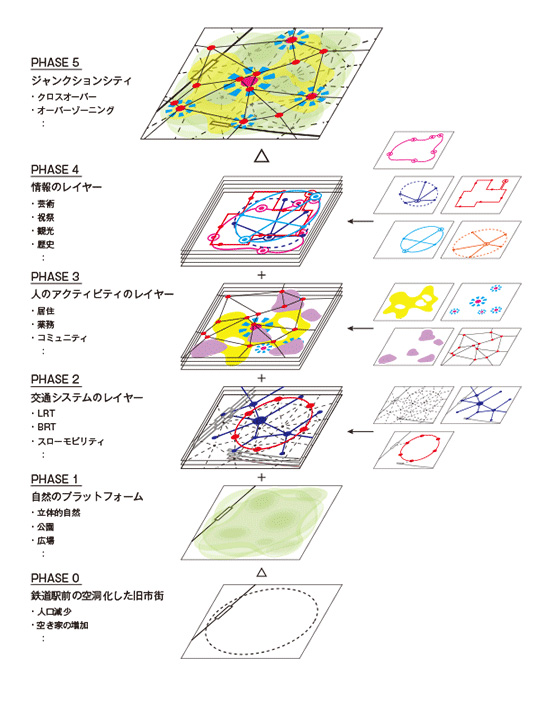
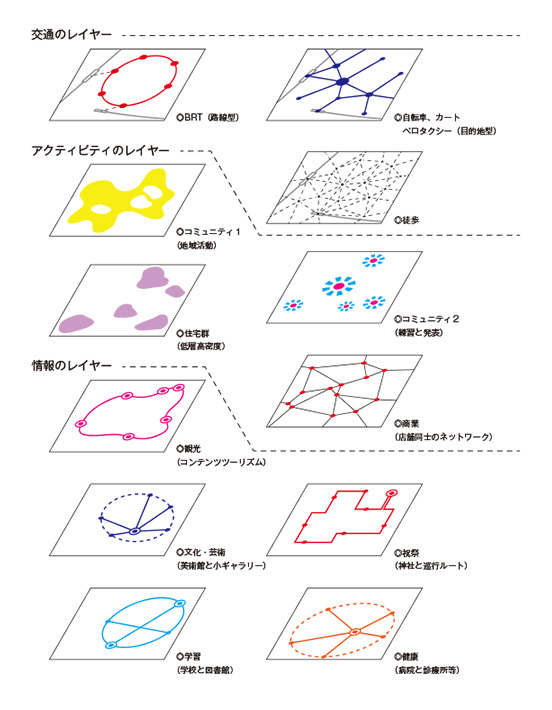
Urban nodes are composed of various layers. By analyzing these layers and providing the necessary elements, we believe it is possible to generate new vitality.
this projectPDF dataYou can also view it at.